
Parking Lot Striping in Lansing, MI
Lansing Best Asphalt Paving stripes parking lots for stores, offices, churches and apartment buildings, from fresh paint over faded lines to a full layout on new asphalt. East Lansing, Okemos and Holt lots are closest to us, with DeWitt, Grand Ledge, Mason and Williamston a little farther, and Charlotte or St. Johns for the larger jobs.
Request a quote
Your name, your number and the street the pavement is on. A callback follows.
It's much cheaper to figure out how many accessible stalls you can put into a parking lot before any paint goes down on the lot. For obvious reasons, it's expensive to restripe. One in six accessible stalls should be van-accessible, so allow that much room for that type of stall.
- Accessible stalls counted against the ADA table
- Old layout measured before any paint goes down
- Half the lot open while the other half dries
- Restripe booked for the week of the seal coat
- Arrows and stall numbers priced item by item
Estimate the striping for your lot
Typical prices per stall for Lansing jobs. Your quote follows a look at the job.
$160 to $200
Call (517) 878-2459 for your priceAt a glance
| Item | Typical figure |
|---|---|
| Standard stall | $4 to $5 each |
| Accessible stall | $25 to $40 each |
| Lot of 30 to 50 stalls | $500 to $1,200 with arrows and crosswalks |
| New layout against a restripe | 20 to 50% more |
| Trip charge | $150 to $350, usually inside the estimate |
| Accessible stalls, lot of 26 to 50 | 2, at least 1 van-accessible |
Parking Lot Striping Services
Restriping Faded Lines
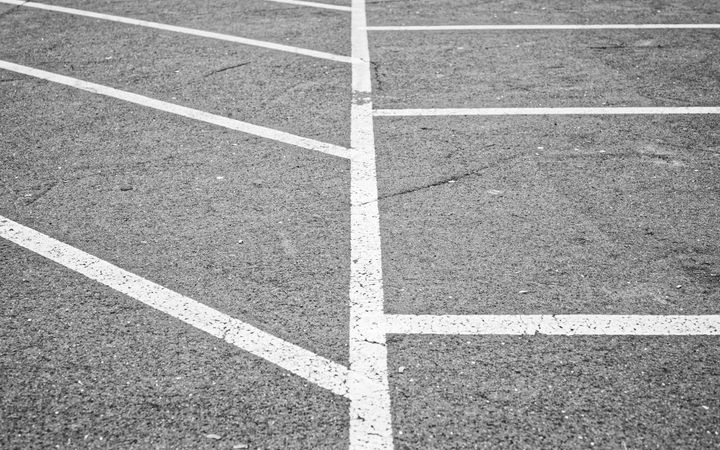
If your lot is in a climate where there is considerable snowfall, then restriping will most likely be needed every once in a while, as snowplows scrape the existing paint. This will also depend on how much traffic this particular lot will get during the year. The more traffic, the more the existing stripes will wear off. If the new paint that is going down for the stripes can follow the old layout, the price for this is typically $4 to $5 per stall.
New Lot Layout
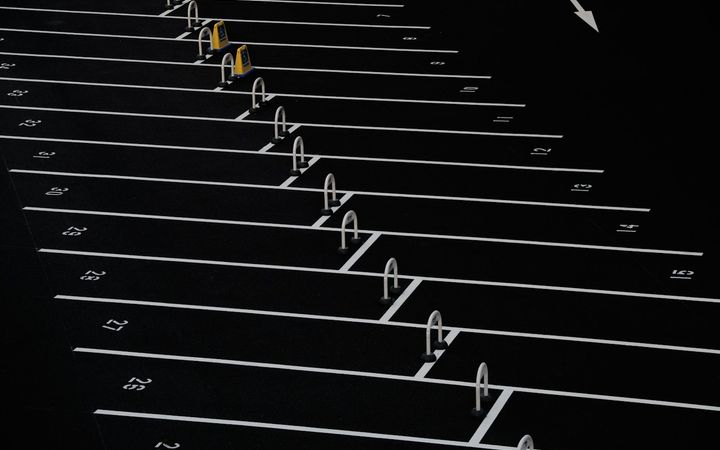
Fresh asphalt, or a lot being rearranged, has nothing to follow. The plan gets drawn first, with stall widths and drive aisles fitted to the lot's measurements. A stall usually gets 8 feet 6 inches to 8 feet 9 inches of width. On the pavement, the corner of each row is squared with a tape before the chalk lines are snapped and painted. Expect 20 to 50% more than a restripe.
Accessible Stalls and Signs
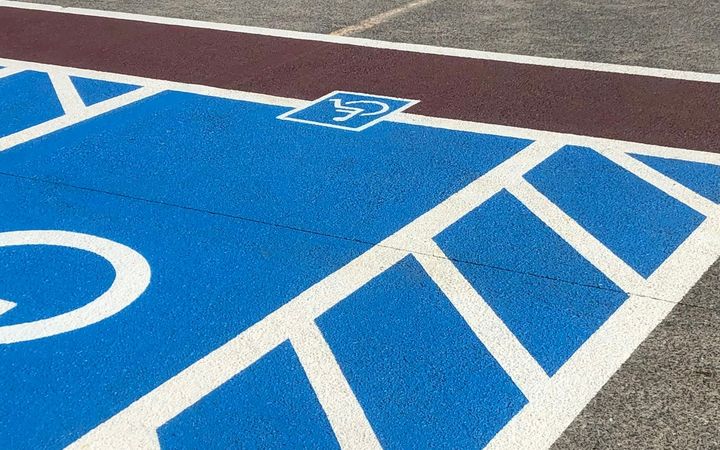
An accessible stall will be a stall with a symbol plus a marked aisle. The painted aisle should always run the full length of the stall. This stall should be fairly level and never any steeper than 1:48. There should also be a sign at each accessible stall that is always visible, with its bottom a minimum of 60 inches high in order for people to see it easily.

Arrows, Stop Bars and Crosswalks
Arrows keep a one-way aisle one-way, and a stop bar puts drivers at the same place every time before the street. Where the walk from the accessible stalls crosses a drive aisle, the ADA Standards' advisory notes say a marked crossing makes it safer. An arrow or a stop bar usually runs $10 to $30 and a crosswalk at $35 to $75.
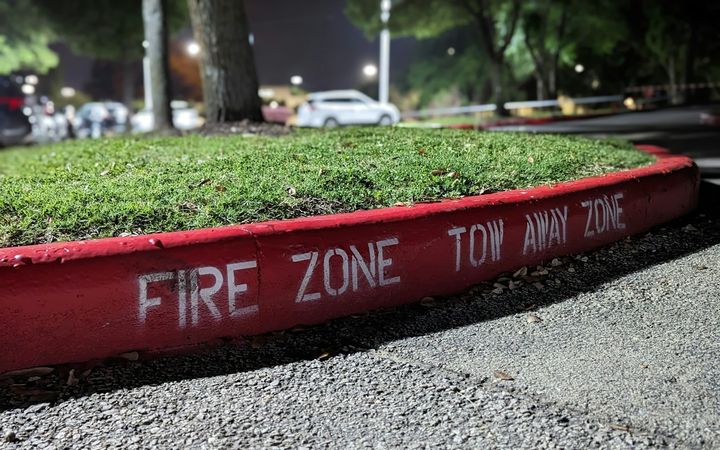
Fire Lanes and Curb Painting
A fire lane or a loading zone usually gets lettering on the pavement, and often a painted curb beside it. The lane usually runs $35 to $75 and curb paint $0.75 to $1.00 a linear foot.
More Striping Work
Stall Numbers and Reserved Spots
Apartment lots with assigned parking and offices with reserved spaces get numbers or names stenciled at the head of each stall. It usually runs $2 to $5 per letter or number, so "VISITOR" across eight stalls adds up faster than the lines do.
Lines After a Seal Coat
A seal coat buries every line on the lot. Plan for that. The stripes go back on once the sealer has dried, ideally the same week, so nobody pulls into a blank lot on Monday morning and parks across two stalls.
Paint Over Cracked Pavement
Paint sticks to what's under it, so a line laid over alligator cracking breaks up with the asphalt. Those spots get patched first, or the money goes into paint that's gone by spring.
How a Parking Lot Gets Striped
Count what the lot has
Every stall gets counted, then the accessible ones, and the total is checked against the ADA table below. Faded arrows and the spots where cars cut across a row go on the same sketch.
Look at the pavement under the paint
Potholes, alligator cracks and low spots that hold water show up now. Striping over them is a waste, so they get priced as a separate line, with the choice left to the owner.
Clean the lines
Dirt and loose stone are blown off along every stripe, toward the lot and never out into passing traffic. Paint laid on dust peels up in sheets.
Sign the entrances and close half
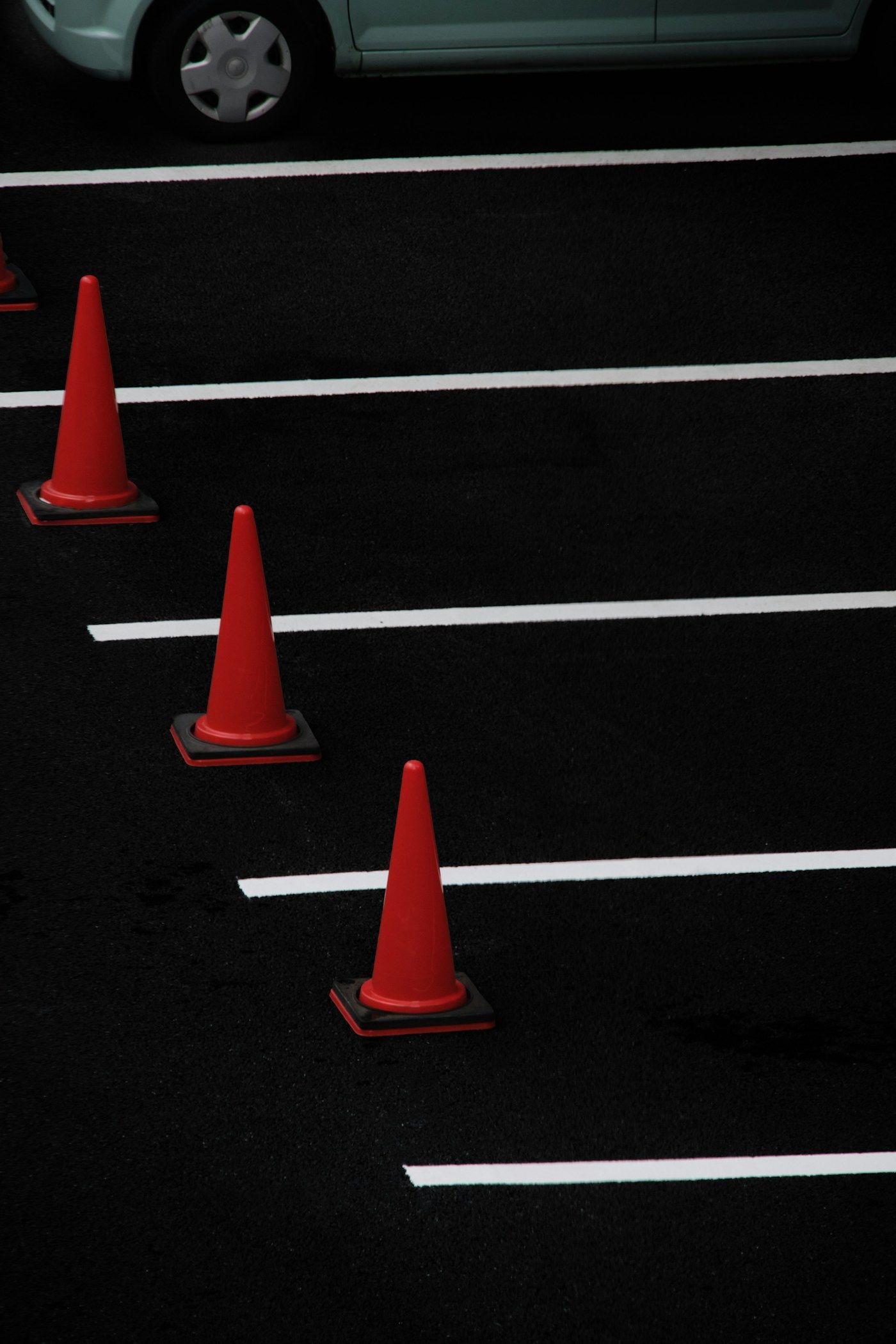
Cones and signs go up at each driveway before the striper starts, so customers can still find the way in to the open half.
Paint and stencil
The machine follows the old lines or the snapped chalk. Symbols and stall numbers go down through stencils.
Keep cars off until it’s dry
Cones stay up until the paint has set, then the crew moves to the other half and does it again.
Restripe it now
When you hear the term restripe it now, this means the lines are still visible but unreadable from a car. The asphalt should also be in great condition and draining properly. If the information that is painted currently can be read from the car, then you can wait longer to restripe.
Fix the pavement first
If the stripes cross potholes or webs of cracks, paint now means paying for it twice. Patch the bad spots, seal the cracks, and stripe afterward on one firm surface. The parking lot paving and repair page sets out when patching is enough and when a lot needs an overlay instead.
If it is approximately a 40-stall lot and has faded lines and cracks across about a third of the lot, we would restripe with arrows. If there is a good budget, sealing the cracks first, then striping could be another way to go for you.
How Many Accessible Stalls Does a Lot Need?
One for a lot of up to 25 spaces, and one more for each further block of 25 up to 100. That’s Table 208.2 of the 2010 ADA Standards. For every six accessible stalls, or part of six, at least one has to be van-accessible. So a lot with a single accessible stall makes that one a van stall.
| Total spaces in the lot | Accessible stalls required |
|---|---|
| 1 to 25 | 1 |
| 26 to 50 | 2 |
| 51 to 75 | 3 |
| 76 to 100 | 4 |
| 101 to 150 | 5 |
| 151 to 200 | 6 |
Where they go matters as much as the count. Section 208.3.1 puts them on the shortest accessible route to an accessible entrance, and a lot that serves two entrances spreads them between the two. In our view, a restripe is the time to move a stall that sits at the back of the lot. The federal standard leaves the color and the pattern of the aisle marking to state and local rules, and that local rule gets checked before the paint goes down.
What Parking Lot Striping Costs in Lansing
A lot of 30 to 50 stalls, arrows and crosswalks included, costs $500 to $1,200 across the US. Plain stalls run $4 to $5 each.
| Item | Typical price |
|---|---|
| Standard stall | $4 to $5 |
| Accessible stall | $25 to $40 |
| Stop line or bar | $10 to $30 |
| Directional arrow | $10 to $30 |
| Crosswalk | $35 to $75 |
| Fire lane or loading zone | $35 to $75 |
| Stenciled letters and numbers | $2 to $5 each |
| Curb painting, per linear ft | $0.75 to $1.00 |
| Mobilization | $150 to $350 |
These are national ranges, read in 2026. No published striping figure exists for zip 48912, so there’s no Lansing number to set beside them. Signs and posts aren’t in these prices, and neither is any patching the pavement needs first.
The mobilization fee is why we’d book the striper for the week the seal coat goes on. One trip covers both, and on a small lot that fee can come to more than the paint itself.
What affects the price
Every job is quoted after we see it. These are the things that move the number up or down.
New layout or restripe
Drawing a lot from scratch runs 20 to 50% above painting over lines that still show
Line width
4 inches is standard, and many striping companies charge more for 6-inch lines
Symbols and lettering
Every arrow, stop bar, crosswalk and stenciled number carries its own price
Trip charge
A $150 to $350 mobilization fee weighs more on a 12-stall lot than on a 200-stall one
Accessible stalls
$25 to $40 apiece with the symbol and the marked aisle, against $4 to $5 for a plain stall
Parking Lot Striping in nearby areas
Parking Lot Striping FAQs
What does parking lot striping mean?
Parking lot striping, also called line painting, is painting down all of the stall lines, symbols, arrows and lettering that go on all parking lots. If you can get away with restriping, which means painting over existing lines, then this is a much cheaper way to go than a whole new layout.
How long does parking lot striping last?
Parking lot striping can typically last around two to five years, and this depends on how much traffic the parking lot gets, the weather, how well the parking lot was cleaned off and the quality of the paint used for the lines.
How soon can cars park on fresh stripes?
In decent weather, cars can begin using the parking lot about an hour after the lines have been painted. Complete drying and curing will take about four hours in a good climate. In cool, damp weather it can take a day or even a couple of days to dry.
How wide is an accessible parking space?
A typical car space should be at least 96 inches wide. Access aisles in a parking lot should be a minimum of 60 inches, while van spaces should be a minimum of 132 inches wide, quite a bit wider than a car space. A van space could also be 96 inches with a 96-inch aisle.
How wide are parking lot stripes?
A typical parking lot stripe is four to six inches in width, with four inches being the standard across the nation. Wider lines will cost extra to paint on and are only needed where a line must stand out on the lot.
How long does it take to stripe a parking lot?
A typical small lot can take several hours up to a full day to complete the striping process. If it is a big parking lot with a brand new layout, this can take several days to complete.
What should a striping quote list?
A striping quote should spell out how many stalls and how many accessible stalls there are. Also, each arrow and stencil should be priced out. The line width and whether it is a restripe or a layout should also be in writing. Also include the trip charge if that is part of the total.
Get a quote on your parking lot striping
Tell us roughly how big the driveway or lot is and what you see on it: cracks, low spots, crumbling edges, potholes. We call back with the fix that fits and a ballpark for it.
Request a quote
A call to (517) 878-2459 gets you a ballpark soonest. Or send the form and we phone you back.