
Driveway Resurfacing and Overlay
A new layer of asphalt over a Lansing driveway whose base still holds, milled flush at the garage and apron, or a straight answer that the drive needs replacing.
Lansing Best Asphalt Paving offers asphalt paving in Williamston, MI, which takes in driveway paving, seal coating and asphalt repair for Williamston homes.
Request a quote
Your name, your number and the street the pavement is on. A callback follows.
Few things here. First of all, wet right up to the surface in spring, and during the winter the frozen water would swell and lift the asphalt, as well as some thin drive and shallow base would also crack during the winter. So deeper base and the crown to keep it flat.
It's quite interesting that more than half of the houses were built more than 26 years ago. That means for those houses there have been 20 years of winters and springs, which gray out the asphalt and produce long cracks that we fix.
When we work on Downtown Lots on Grand River Avenue, it's usually shops, restaurants or offices along M-43 with small lots behind them. We pave them in halves on a closed day, and the alley itself is kept open for deliveries. We also often do some patching, for example a mill-off and repave at curb height.
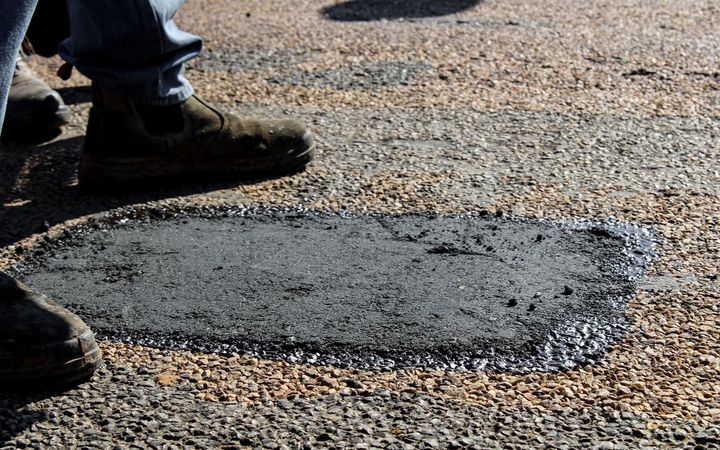
About 28% of the ground near the center is urban land: soil dug up and filled back over sewer, water and gas lines. Fill that was not packed tight keeps settling, and a drive across it dips in a straight line. We cut out the dip, pack the trench in layers and patch it flush.
Many 1990s drives have already been overlaid once, and the second one needs a firm base. Each layer adds around 2 inches. So what we do is mill down along the garage floor and the walk, and ensure that it’s all at the same level.
There are a few things here to consider. If you need to work on business and apartment lots, they must be asphalt or concrete. If it’s a new parking area, you need a zoning permit, so you need to call the zoning administrator under Sec. 74-9.102. Keep in mind that when you want to pave at your own house, the drive and parking must be at most 40% of the front yard. If it’s a state highway, MDOT is your point of contact, and for an Ingham County road, the Road Department in Mason. And if there’s work in the street, the city right-of-way permit applies as well.
Williamston lies 20 miles east of Lansing by road, about 26 minutes out Grand River Avenue or I-96.
We also serve DeWitt, MI, a short drive north of Lansing up US 127.
Williamston has a population of about 3,849. Here is what that means for the work we do here.
| Local fact | Detail |
|---|---|
| Homes from the 1990s and 2000s | 39% of the city's 1,903 homes; another 17% date from before 1940. |
| Median year built | The median home in Williamston dates from 1977 . |
| Wet soils near the center | Gilford sandy loam and Colwood-Brookston loams, about 23% of the square mile, hold water right at the surface in spring. |
| Frost action | Rated high for Gilford, Colwood, Brookston and Capac, the wetter soils in town. |
| Urban land | About 28% of the ground near the center is mapped as urban land, soil already dug and filled. |
| County | Ingham County; M-43, Grand River Avenue, runs through downtown. |
A new layer of asphalt over a Lansing driveway whose base still holds, milled flush at the garage and apron, or a straight answer that the drive needs replacing.
Potholes, alligator cracking, broken edges and low spots on Lansing driveways and lots, cut out and patched in hot mix down to a firm base.
Cracks in Lansing driveways and lots blown clean and sealed with hot rubberized sealant, or filled where they barely move, before winter water gets under them.
Patching, crack sealing, milled overlays and new asphalt lots in Lansing, priced after the drains and the base have been checked.
Milling the worn top off Lansing lots, private roads and drives so the new asphalt keeps curb and drain heights, with the depth set to the damage.
That spot has sunk, or it was never pitched. If the asphalt around it is sound, a light leveling layer can bring it back up. If it is soft underfoot, the base under it has failed and that patch has to be dug out.
The edge stands above the grass with nothing beside it, so tires and plows crack it off. We cut the broken edge back to solid asphalt, repave the strip, and pack soil along the side up to the top of the new edge.
Often, yes. A geotextile fabric is a sheet laid on the soil before the stone goes down. It keeps the soggy soil from working up into the stone, which is what softens a base over the years.
It's possible, but only on dry days when it's above 50 degrees. It's quite challenging, because hot mix plants usually close by late November. We would not work on colder days, because cold asphalt cools before it packs. During those months we only work on the warmest days.
What we do is pave only the first half, then let it cool for a few hours, and then we pave the other half. The neighbor can use the open side while the other one is still being worked on.
Yes, we can. What we do is pave up to the post, then seal the gap around it. When the concrete footing sticks up, we pave to its edge.
Tell us roughly how big the driveway or lot is and what you see on it: cracks, low spots, crumbling edges, potholes. We call back with the fix that fits and a ballpark for it.
A call to (517) 878-2459 gets you a ballpark soonest. Or send the form and we phone you back.